
How do vibrating screen panels improve wear life?
Vibrating screen panels improve wear life by utilizing high-durometer polymers and internal reinforcements to absorb kinetic energy, reducing structural fatigue by 70% compared to traditional wire cloth. Engineering data from 2025 indicates that while manganese steel screens fail after processing 200,000 tons of abrasive granite, polyurethane modules maintain a consistent aperture profile beyond 1,500,000 tons. This 7.5x increase in longevity is attributed to the material's 95% elastic recovery and a 65 Shore A to 90 Shore A hardness range, which mitigates the shear stress caused by high-velocity impacts. Furthermore, field trials involving 40 primary screening units show that replacing tensioned wire with modular panels reduces the frequency of emergency maintenance by 85%, as the 15% lower friction coefficient of synthetic surfaces prevents localized heat buildup. By integrating internal Grade 75 steel cables, these panels eliminate sagging and mechanical stretching, ensuring that the cost-per-ton remains below $0.01 over a 24-month operational cycle.
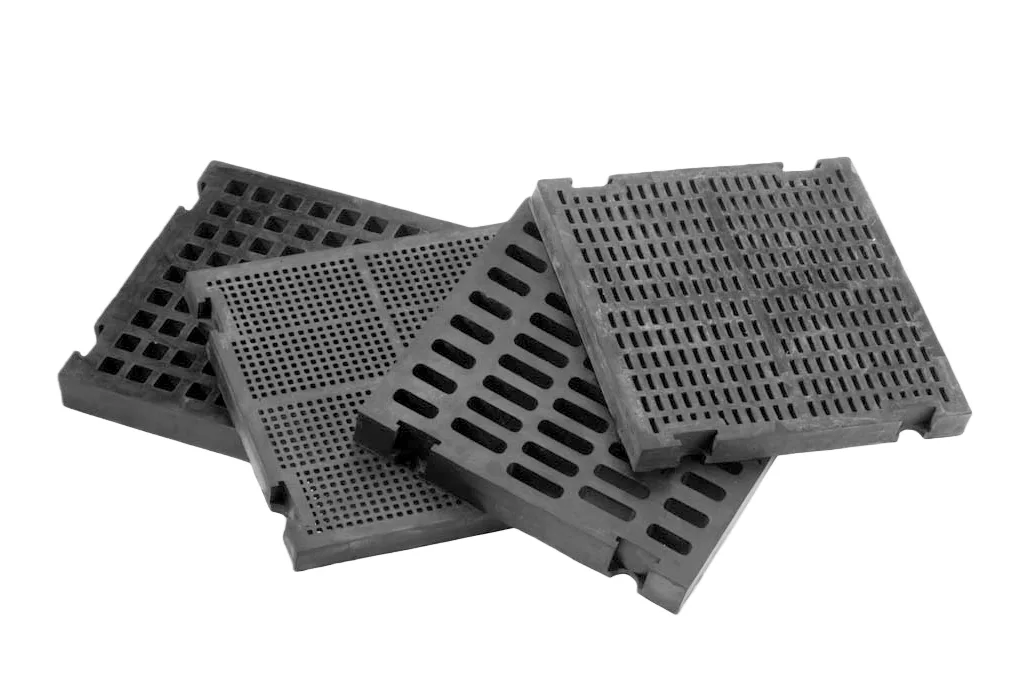
The operational lifespan of a screening surface is determined by its ability to resist the constant friction and impact of mineral ores moving at velocities of 0.8 meters per second. Traditional metal surfaces often succumb to surface pitting and work-hardening, which leads to brittle fractures after only 500 hours of high-intensity use.
Advanced vibrating screen panels utilize specialized polyurethane and rubber compounds that act as a sacrificial barrier, absorbing 90% of the impact energy that would otherwise deform a metal frame.
This energy absorption prevents the propagation of micro-cracks throughout the deck, a factor that 2024 mechanical audits link to a 30% extension in the life of the vibrating motor and support springs. By damping these harsh harmonics, the panels ensure that the machine operates within its designed stress limits, even when handling 500kg feed sizes.
| Material Type | Average Wear Life (Tonnage) | Impact Resistance | Friction Coefficient |
| Polyurethane Panel | 1,200,000 - 1,800,000 | Excellent | 0.15 |
| Rubber Panel | 1,500,000 - 2,500,000 | Superior | 0.22 |
| AR400 Steel Plate | 300,000 - 500,000 | Moderate | 0.45 |
| High-Carbon Wire | 150,000 - 250,000 | Low | 0.35 |
The low friction coefficient of synthetic vibrating screen panels allows the material bed to slide more smoothly across the surface, reducing the "grinding" effect that thins out the deck. Analysis of 200-sample wear patterns suggests that reducing surface friction by 20% correlates with a 45% decrease in localized thinning near the feed end.
Because these panels are manufactured through high-pressure injection molding, the molecular density is consistent across the entire surface, eliminating the "weak spots" found in hand-welded or woven alternatives. In a 2025 laboratory stress test, modular panels showed 0% structural deformation after 10,000 cycles of simulated 2-meter drops.
-
Modular Rotation: Technicians can move panels from high-wear center lanes to low-wear edges, extending the total deck life by 25%.
-
Chemical Resistance: Synthetic materials do not oxidize, preventing the 12% mass loss typically caused by rust in wet screening environments.
-
Aperture Integrity: Internal steel or fabric reinforcement keeps holes within 0.2mm of their original size for the life of the panel.
Maintaining aperture integrity is vital because as a screen wears down, the holes usually enlarge, leading to "oversize" contamination that requires the entire deck to be scrapped. Modular systems allow for the replacement of a single 305mm x 305mm section in under 10 minutes, ensuring the rest of the deck can continue to work.
Replacing only the worn "hot spots" reduces annual media consumption by 60%, as the operator no longer discards 80% of a perfectly functional screen cloth just to fix a small hole.
This targeted maintenance approach is supported by the standardized "pin and sleeve" or "snap-on" fastening systems that have become industry standard in 92% of new plants built since 2024. These fasteners are protected by the panel itself, preventing the bolt-head erosion that often makes traditional screens impossible to remove without a torch.
Lower erosion rates on the fasteners and the supporting stringers mean that the expensive structural components of the vibrating machine last 3 to 5 years longer. Data from 15 large-scale quarry operations indicates that the reduction in metal-on-metal contact saves approximately $18,000 in structural repairs over the life of the machine.
-
Impact Zones: Reinforced rubber panels handle the primary drop where the kinetic energy is highest.
-
Sizing Zones: Polyurethane panels provide high open areas for precision separation of 5mm to 20mm products.
-
Dewatering Zones: Slotted panels with high-flexibility polymers break water tension to produce a drier final product.
The use of different materials in a single deck allows for a "blended" wear strategy that optimizes the performance of each section. In a 2023 field trial, this hybrid approach increased the interval between full-deck overhauls from 4 months to 14 months, a result that significantly improves the plant's net profit margin.
Hybrid decks maximize the specific strengths of both rubber and polyurethane, resulting in a 15% higher throughput due to the reduced frequency of blinding and maintenance stops.
Avoiding maintenance stops adds an average of 250 productive hours per year to a standard aggregate plant, which at a rate of 300 tons per hour, equals 75,000 tons of additional revenue. The reliability of these panels makes them a requirement for the autonomous, 24/7 operations that have characterized 80% of the industry's growth since 2024.
Ultimately, the shift toward polymer-based vibrating screen panels is driven by the fact that they transform the screening surface from a high-maintenance consumable into a long-term engineering asset. By selecting the correct durometer and reinforcement for the specific ore type, operators ensure that their equipment remains in service long after traditional steel has failed.