
From Brief to Approved Sample: A Seasonal Collection, Step by Step
From brief to approved sample is a sequence of about seven stages, and each one ends with a named output: a signed brief, a set of candidate vials, trial units in the real base, a compliance summary and a sealed reference. Product development teams that track the outputs rather than the weeks find the calendar becomes predictable, because the only thing that moves a seasonal launch is an output that has not been produced yet.
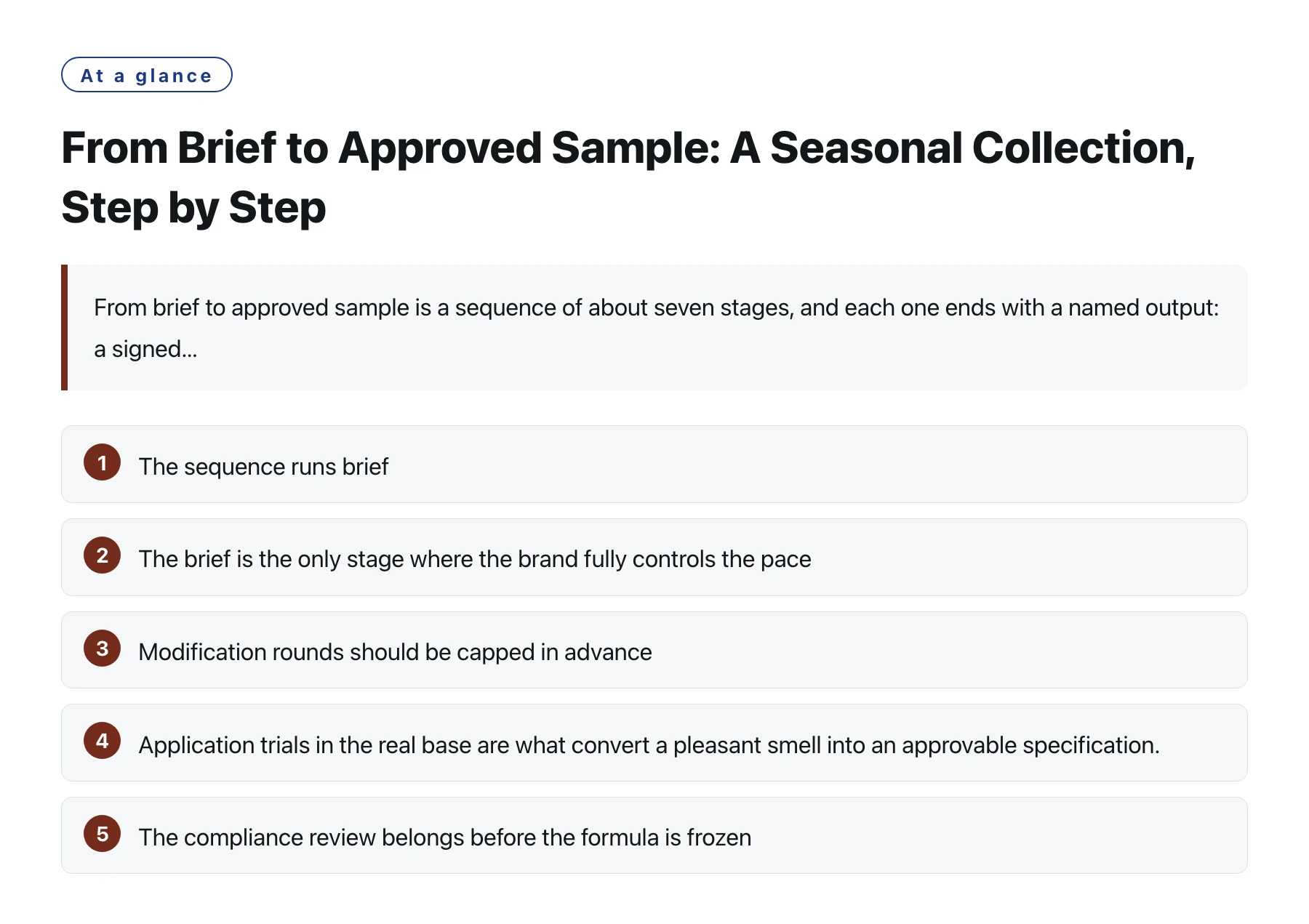
Key takeawaysThe sequence runs brief, direction, modification, application trial, compliance review, confirmation sample and sealed reference, and each stage has a single output that closes it. · The brief is the only stage where the brand fully controls the pace; every later stage depends on a decision taken there. · Modification rounds should be capped in advance, so the creative process has a countable boundary rather than an open one. · Application trials in the real base are what convert a pleasant smell into an approvable specification. · The compliance review belongs before the formula is frozen, because restricted-material and allergen findings at that point cost a draft edit rather than new artwork [1].
A seasonal collection is usually described as a creative project, and it is, but the part that determines whether it ships on time is procedural. The stages are stable, the outputs are stable, and the sign-offs can be named in advance.
This walkthrough is written from the point of view of a product development manager who owns the schedule and has to report progress weekly. It assumes the range plan exists and the launch window is known, which in practice is where most seasonal work starts.
Nothing here is specific to a product category. A home fragrance drop and a body care drop run the same sequence, with different bases and different testing emphasis.
Before the sequence starts: the two decisions that gate everything
Two decisions sit upstream of the sequence itself, and if either is left open, the stages below will keep reopening. The first is the item list: how many products the drop contains and in what formats. The second is the cost ceiling per unit at the volume the range plan assumes.
Both are commercial decisions rather than perfume decisions, which is exactly why they are often postponed. Postponing them does not save time; it moves the discussion to a later stage where the same decision costs more.
The supplier's scope should be settled at the same moment. Whether development, filling and packing sit with one partner or several changes which stages are yours to run. A manufacturer that publishes its service boundaries, such as the scope set out here — Click here — makes that splitting exercise much easier to do.
The item list fixes the number of trials
Every distinct base in the drop needs its own application trial. Three items that share one carrier need one trial; three items across a spray, a cream and a wax need three. Until the item list is settled, the sampling cost and the schedule cannot be estimated.
The ceiling fixes the palette
A unit cost ceiling constrains which materials a perfumer can build with, and it is far cheaper to state it at the brief stage than to discover it after a direction is loved. Where the ceiling is tight, say so early and let the perfumer work inside it.
The sequence, stage by stage
- Stage 1 — Written briefThe brand states direction, target markets, item list, dosage, bases and cost ceiling, and names one approval owner. Output: a dated brief version, signed.
- Stage 2 — Direction and candidate compoundsThe perfumer responds with one to three candidate directions, each matched to the brief. Output: a set of labelled candidate vials with a short written rationale for each.
- Stage 3 — Modification roundThe brand selects the direction that fits and requests specific changes, not general impressions. Output: a revised compound with a written change note against the previous version.
- Stage 4 — Application trialThe chosen compound is tested in each base in the drop, at the intended dosage, and evaluated on skin where relevant. Output: trial units plus a record of base, dosage and test conditions.
- Stage 5 — Compliance reviewRestricted-material headroom, allergen declaration and label wording are checked against the target markets. Output: a compliance summary and the confirmed declaration list.
- Stage 6 — Confirmation sampleA final sample is produced to the frozen specification, matching the batch process as closely as a lab batch can. Output: the confirmation sample and the specification it was made to.
- Stage 7 — Sealed referenceThe confirmed sample is sealed, labelled with the approval date and stored as the standard for the bulk comparison. Output: the retained reference, plus the signed approval record.
What each stage produces, and what closes it
| Stage | Output that closes it | Decision required |
|---|---|---|
| Written brief | Signed, dated brief version | Approval owner confirms direction, bases, dosage and ceiling, and settles whether an an OEM partner for perfume brands writes the specification or the brand does |
| Candidate directions | Labelled vials with written rationale | One direction goes forward; the rest are stopped |
| Modification round | Revised compound and change note | Either accept the revision or take one more capped round |
| Application trial | Trial units in each base | Scent confirmed in the base it will be sold in |
| Compliance review | Declaration list and label wording, checked against the target markets [2] | Formula frozen; changes after this point cost artwork |
| Confirmation sample | Sample made to the frozen specification | Approval recorded against the reference |
| Sealed reference | Retained standard sample | Bulk order released against this reference only |
Notice that only one stage is genuinely creative. The rest are checks, and that is the point: a seasonal collection does not fail because the perfumery was not inventive enough, it fails because one of these outputs was never produced. Read the table as a checklist of outputs rather than as a sequence of meetings, and the stage that is behind schedule becomes visible immediately.
The most common schedule failure in this sequence is a modification round that never formally closes. A direction is chosen, changes are requested, a revised vial arrives, and the team keeps the previous candidate on the table 'just in case'. Two things then happen: the factory cannot tell which specification is live, and the approval that eventually happens is against a sample nobody can identify with certainty. Close each round in writing. Two sentences are enough, and they protect the calendar as much as the paperwork.
Running the sequence when several items share one scent
Seasonal drops often reuse one scent direction across several formats, which is efficient and slightly deceptive. The sequence runs once for the scent and again for each base, because the trial stage is where the format proves itself.
The practical approach is to run stages one to three once, then branch at stage four. Each base gets its own trial and its own recorded result, and all of them reference the same approved compound. The compliance review then covers the whole family, since the declaration list depends on the finished products rather than on the compound alone. If you want to see how the production side of the sequence is described at the factory end, the overview of the full perfume manufacturing process is a useful counterpart to this development view.
This structure also keeps the cost picture honest. One direction and three trials is a very different budget from three directions and three trials, even though the brand experiences both as 'one seasonal round'. If you are working with a partner that supports both development-led and specification-led work, the distinction between those models matters at exactly this point, and it is worth confirming which one applies before the brief is finalised.
Whatever the structure, the reference vial at the end must be unambiguous. If three bases were approved, three references are retained. The bulk order is then compared against each of them, and the launch stops depending on anybody's memory of what was agreed in the meeting.
Sources
- IFRA Standards Library (International Fragrance Association) —— The IFRA Standards Library lists the restrictions the fragrance industry applies to individual fragrance ingredients, based on safety assessments; it is the reference point for compliant fragrance formulation.
- European Commission: Cosmetic Products — Specific Topics —— EU pages covering specific cosmetics topics such as product claims, nanomaterials and animal-testing rules.
Frequently asked questions
How long does it take from brief to approved sample?
It depends on the number of directions, the number of bases and how quickly decisions are returned. The stages themselves are usually not the bottleneck; the gaps between them are. Teams that name an approval owner and answer within a fixed window typically move through the sequence far faster than teams that meet to decide.
How many modification rounds should a seasonal collection allow?
Set the number in advance, usually two, and agree the cost of a further round. A capped number converts an open creative process into a countable one and gives everyone a reason to make the brief precise from the start.
Can the compliance review happen after the sample is approved?
It can, but it should not. If a restricted-material or allergen finding appears after approval, the formula changes, which means the sample is no longer the approved one and the artwork may need to be redone. Review before freezing.
What if the confirmation sample smells slightly different from the approved trial?
That is a reason to compare them side by side rather than to assume a problem. Records help here: if the trial and the confirmation were made to the same specification, any difference should be small and attributable to a documented variable such as resting time. If the difference is large, treat it as a specification question.
Do all the items in a seasonal drop need their own reference sample?
Yes, when they use different bases. The reference is what the bulk order is compared against, and a cream and a candle cannot be compared against the same standard. Where items share a base and a dosage, one reference can cover them.